Grid Space
Drop a chart on the board: it lands at a cell, it can be found and commanded by that address, and it answers for its own numbers. That is the whole surface, three ways. Every mark lives at a cell — place, find and command by address. Live, or accountable — never decoration — bound cards refresh from their source; hand cards expire themselves or accumulate. Ask why — get a source — provenance is cargo and survives copy, move and export.
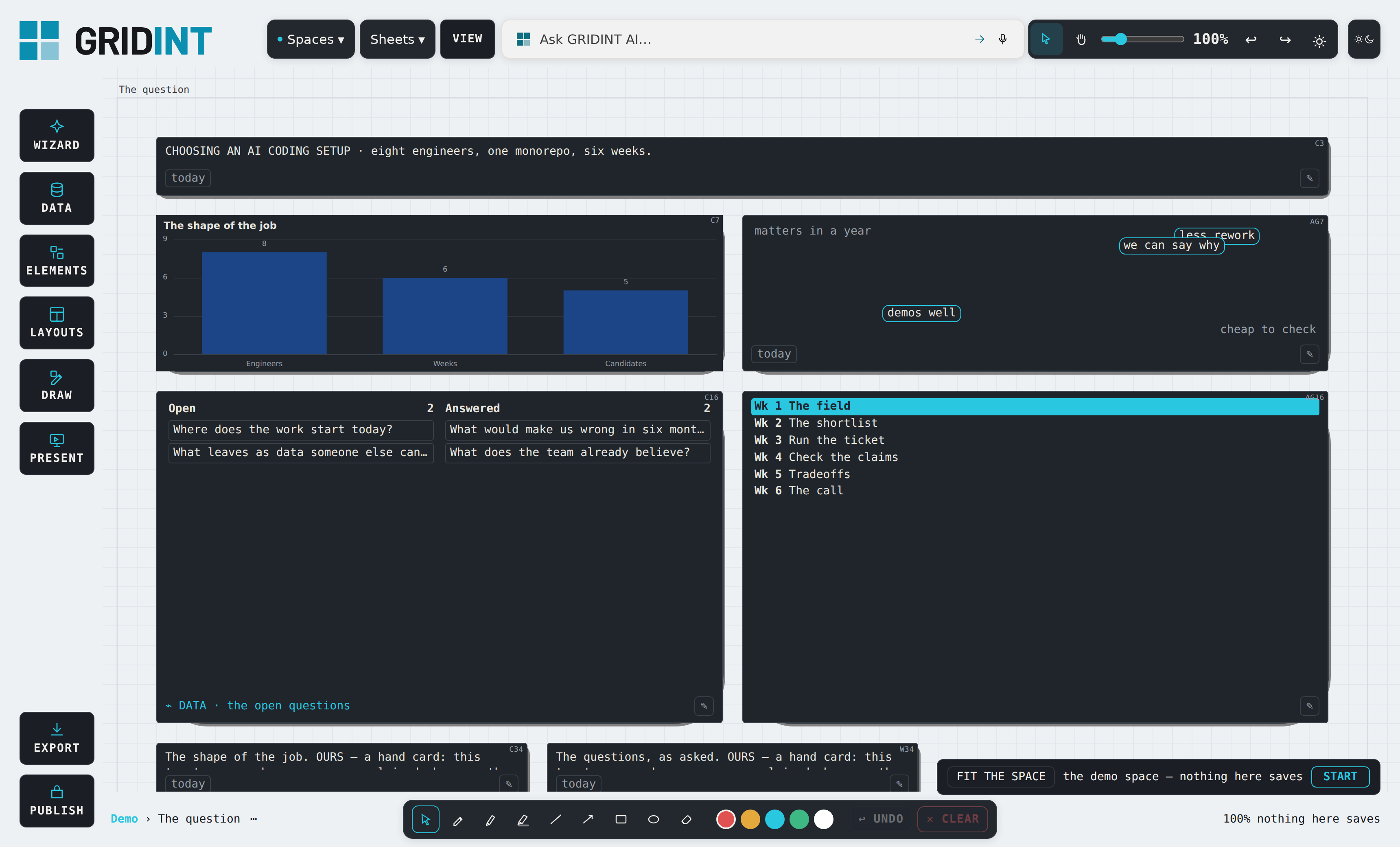
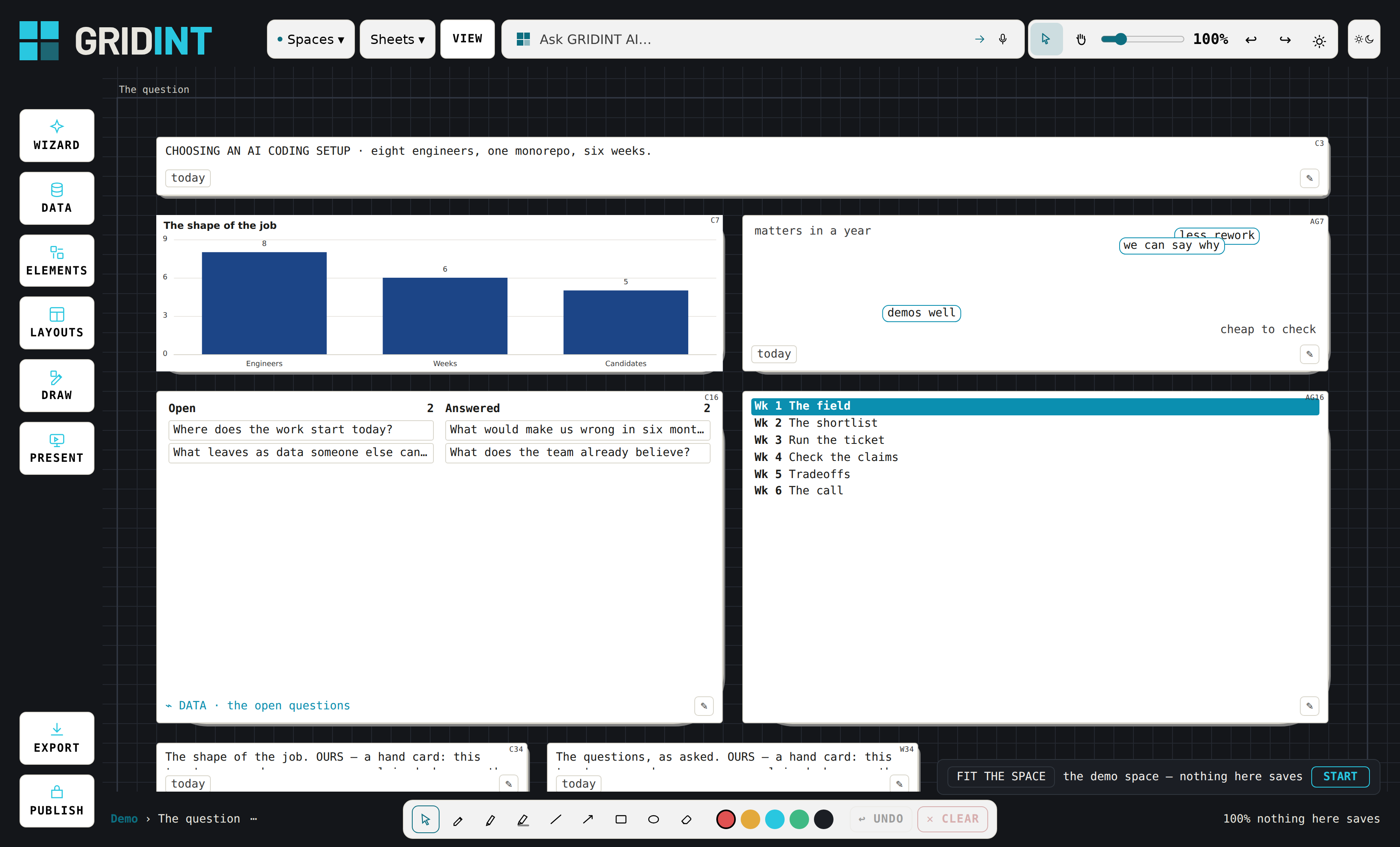
the same board, both shells · captured from demo mode
The anatomy — three ideas, and the hierarchy is the navigation
An infinite, addressed plane
One continuous lattice that never runs out, every cell named — column letters by row numbers, the scheme every spreadsheet reader knows, stretched across an infinite canvas. Addressing is the architecture, not a convenience: it is what lets search land the camera on a cell, lets an AI place precisely, and lets a card cite Sheet!K14 the way a paper cites a page.
search, the AI and a citation all land on the same cell — Sheet!K14
A space keeps a project together
One per project, topic or client — hosted by GRIDINT, owned by you, and yours to export in full. Switching spaces swaps your whole working world in one move.
switching spaces swaps the whole working world — hosted by us, owned by you, yours to leave with
Where the work happens
Fixed-extent regions laid out on the one plane — not separate documents. You never scroll across the kingdom: pick a sheet and the sheet comes to you; the camera flies, the chrome holds still. Navigating is camera movement, never a page load.
pick a sheet and the sheet comes to you — the camera flies, the chrome holds still
A face on a record
Everything placeable is an element: a designed card over a data record. The record carries the facts — series, source, method; the face is how it is painted. Retheming never touches cargo, which is the law that makes provenance survive everything.
THE RECORD — WHAT THE CARD CARRIES
- SERIES
- the numbers themselves
- SOURCE
- where they came from, named
- METHOD
- how they were made
the face paints; the record carries — retheming never touches cargo
The three births — every element wears how it came to be
Placed empty, filled by you
Free, private, yours — and it must expire itself or accumulate.
typed straight onto the board —
no source behind it, just you
hand · aging visible · expires in 12 days
Bound to a source
The card derives from rows and stores no copy — reopening refreshes the binding.
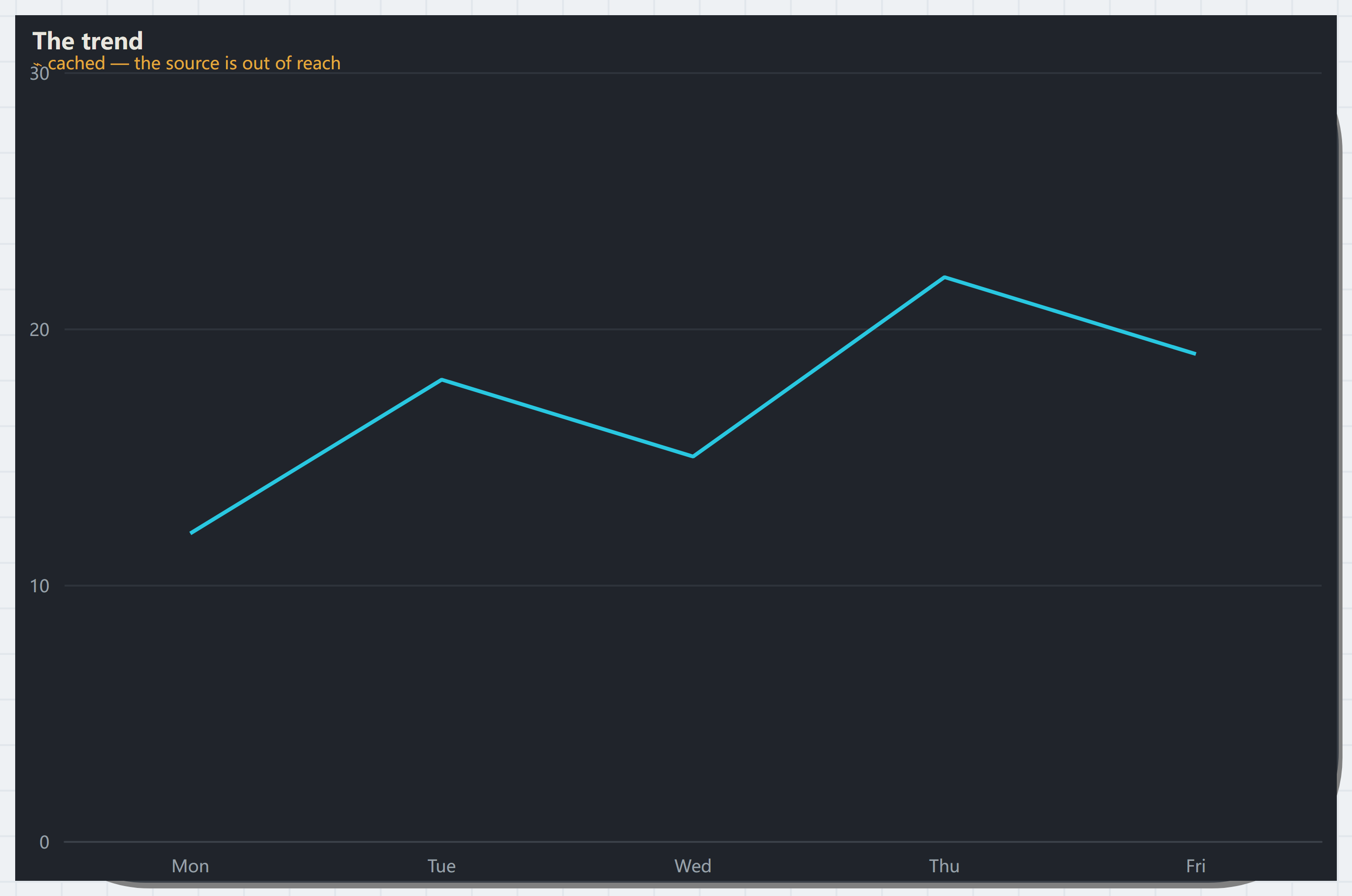 A fed card, mid-demo — its face admits its source state
out loud.captured from demo mode
A fed card, mid-demo — its face admits its source state
out loud.captured from demo mode
bound · its source · refreshed on open cached — the source is out of reach
Recomputed from the board
A number with its method on its face — hide the formula and it is indistinguishable from a typed one.
RUNWAY
4.2 months
= balance ÷ burn
derived · recomputes when the board moves
One placement door — and the AI has no private one
The moment a type and its data are known, the element renders as a live ghost at full fidelity, riding your cursor. Place is the moment of birth — one click creates the record, addressed and wearing its provenance from its first frame. Esc before Place and the record never existed.
AI placement walks through the same door. A model that could place things by a route humans cannot take would be a model whose output nobody could check. Because there is one door, anything the AI does is exactly as inspectable, as undoable and as addressed as anything you do by hand — and behind the door stands a validator that refuses bad records by name, with a fix the model can act on.
move inside the frame — the ghost rides your cursor, cell to cell; click to place
Ask GRIDINT AI — the prompt, and what comes back
Output that is almost right, but not quite — 66 percent, the largest single frustration reported. Not a generation problem. A VERIFICATION problem.
cargo.binding.record = d-frust · scenario: research · source: survey.stackoverflow.co/2025/ai
bound · its source · refreshed on opena real prompt record from the promo board (ps-04 · p-turn) — asked, answered, and bound
Ask in words; get records, not prose. The prompt reads the data in your space and writes finished, addressed visuals straight onto the board — every answer is an element with a record behind it, born through the same placement door as everything else on this page.
The answer alongside is real: asked on a promo board, answered as a note bound to the record that carries the rows. Nothing arrives without a source — the AI cannot bluff a number onto the board.
AI & AI+ — whose key, whose model → · The round trip, step by step → · Product →
The six tools
THE WIZARD — built WITH you · pick an element; its category decides the steps. Data first where data rules; form first where there is none.
The thirty-second shape every build follows: click → type → data → preview → refine → place. Establish the source (paste rows, use the example, drop a file), pick the shape, and the preview redraws from your own rows before anything lands. Insert arms the ghost; nothing lands without your hand.
The data shelf is your space's own spine: every source a record wearing a receipt — what it is, its shape, its coverage, its licence, when it last refreshed. Local files stay local: the shelf remembers the file, not its contents, and SQL runs over attached files in your own browser. The reverse map shows which cards each source feeds — ask "what breaks if this dies" and the answer is on screen. Two data classes, two policies: your data is used to run Grid Space and for nothing else; published corpora we collect are ours, hosted, provenance-stamped.
| source | shape | rows | feeds | licence · coverage |
|---|---|---|---|---|
| Sample rows — replace with your own | note | 5 | 2 bound cards | not stated · not stated |
| The trend | chart | 5 | — | not stated · not stated |
| The breakdown | chart | 5 | — | not stated · not stated |
every source a record wearing a receipt — and where nothing was stated, the shelf says so
One popup, the whole shelf shown as real drawn faces, searchable, categorised. The shelf is a database, not a design commitment — offering an element is adding an entry; what is not ready says so. The full catalogue, with Grid Space's own labels, is further down this page.
readiness pills and births on every face — the honest-labelling claim, visible
A layout is a complete sheet designed before you arrived — furniture placed, working examples in the slots. Inserting one births a new sheet and the sheet comes to you; nothing pre-designed ever lands inside a working sheet.
Starter layouts
inserting one births a new sheet — nothing pre-designed ever lands inside a working sheet
Sketch on the board, and diagram on it — where a diagram is a record, not a picture. You can guess at a picture; you can read a record — which is what makes described, documented diagrams possible downstream.
a diagram here is a RECORD, not a picture — every node and edge carries its type, label and address
Capture scenes from the board, order them, and present from the board — a deck presented from its live source rather than exported last week. The deck starter layout is available today; the fuller present-and-control surface is in build and says so.
Scenes
what is not ready says so — the dimmed states are the honesty, not a gap
The element catalogue — every entry, with its real label
Generated from Grid Space's own shelf manifest (its labels, verbatim: AVAILABLE · IN DEVELOPMENT · PLANNED). Nothing below claims more than the manifest does; entries still in draft are not listed at all.
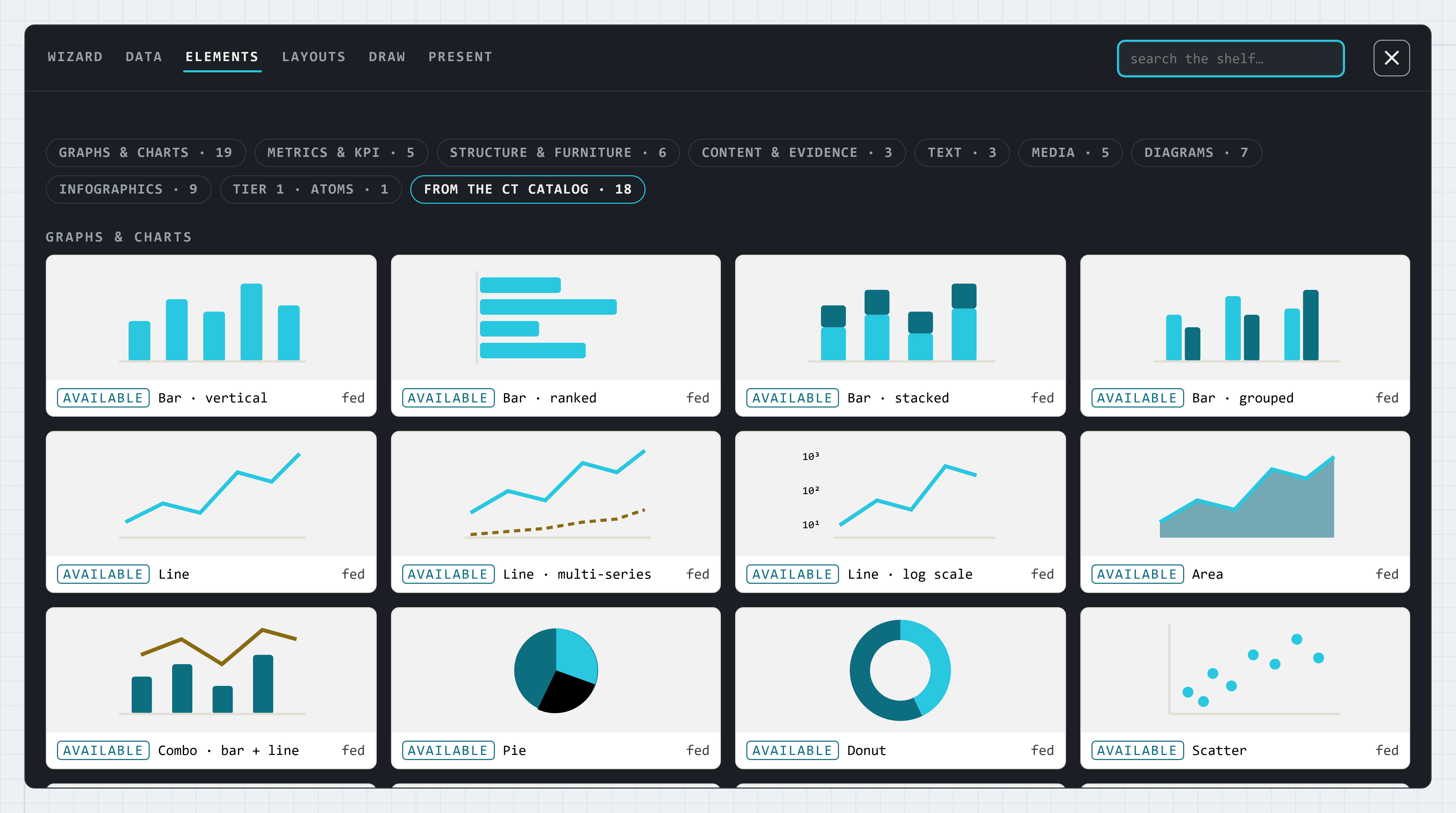 The catalogue as Grid Space shows it — what is not ready says
so, on the card itself.captured from demo mode
The catalogue as Grid Space shows it — what is not ready says
so, on the card itself.captured from demo mode
Every element, every mark — at an address, with its source.
The six tools above are the whole door. What lands through it is yours: addressed, sourced, undoable, and exportable in full.